Intent-based leadership according to David Marquet

How do we define intent-based leadership?
Intent-based leadership is a leadership style that focuses on dialogue between the leader and their team members at the level of intention. It aims to create conditions where there is not one leader and obedient followers, but rather leader-leader interaction. This type of leadership is distinguished by its capacity to create a vision (direction and purpose) for the entire team. The intent-based leader seeks to understand the values, needs and motivations of team members, and to align these elements with the overall objective of the organization. At the same time, they encourage each person to explain, based on the information available to them, their own objective and their own direction. Their intentions will then fit into the overall movement. Thus, each team member is connected to the common mission and encouraged to contribute fully.
"Intent-based leadership is the ability to transform a clear intention into meaningful and inspiring actions." - John Quincy Adams
What are the benefits of intent-based leadership?
Intent-based leadership is recognised for promoting engagement and creativity in each person and maximising personal responsibility. Its implementation in highly varied operational environments results in:
Increasing the sense of personal responsibility and team autonomy
By encouraging team members to make decisions and act autonomously, team members feel more engaged and motivated. They are encouraged to develop confidence in their own skills.
Increasing engagement and motivation for everyone
Involving team members in decision-making by explaining the overall intention increases engagement. This also promotes open communication and active participation, which strengthens motivation and sense of belonging.
Strengthens collaboration between team members or entities
By emphasising the clarity of intention and creating a trust environment, intent-based leadership fosters collaboration and pooling of resources.
Reducing errors and hierarchical dependence
By delegating decision-making power and encouraging autonomous decision-making, intent-based leadership reduces errors or delays caused by excessive dependence on hierarchy. Team members are encouraged to take initiative. They must solve problems themselves, which promotes efficiency and responsiveness.
Promoting innovation and creativity
Valuing the expression of different perspectives, the dialogues generated in this framework can lead to new ideas. From this will emerge innovative solutions and continuous improvement of processes and results.
What are the emblematic references of intent-based leadership?
Many agree that Admiral Nelson pioneered intent-based command. He notably communicated to his ship captains shortly before the Battle of Trafalgar: "In case signals can neither be seen nor perfectly understood, no captain can do very wrong if he places his ship alongside that of the enemy."
Contemporary authors
Several contemporary authors have written and contributed to the literature on leadership. All converge towards the need to put forward intent-based leadership. To name just a few:
Stephen R. Covey, in his book "From Good to Great" ("The 7 habits of those who accomplish everything they undertake"), highlights the concept of personal leadership and the need to clarify one's intention and values to exercise effective leadership.
Daniel Goleman has also addressed intent-based leadership in his writings. His book "Leadership That Gets Results" ("Effective leadership") highlights the importance for leaders of having clear intention and developing their emotional intelligence to inspire and motivate their teams. In his famous "Start With Why" ("Start With Why"),
Simon Sinek popularised the idea that effective leadership begins with a clear intention and an inspiring "why".
All Leaders Initiative and David Marquet
At All Leaders Initiative, we love to work based on the writings of David Marquet. This former US Navy commander transformed his submarine like a liberated company. In his book "Turn the Ship Around!" ("Reverse the course!"), he theorises what he put into practice as a nuclear submarine commander. He tells how he transformed, step by step, one of the fleet's worst crews into one of the most performing teams, by adopting an approach he called the "Intent Based Leadership ®" or "Leadership Based on Intention", that is, a delegation of decision-making power to those closest to the information.
Commander David Marquet shares principles and concrete practices with which he, in a relatively short time, inspired autonomy, developed leadership at all levels, and created a culture of engagement and excellence that lasted long after his departure.
The 6 principles of Intent-Based Leadership ("Intent Based Leadership ®") according to David Marquet? 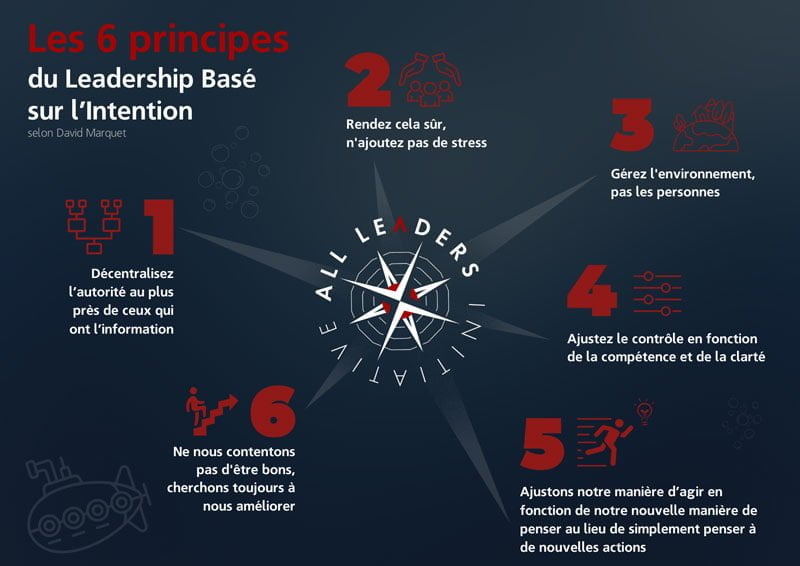 David Marquet, now at the head of Intent-Based Leadership International, states the following 6 principles for Intent-Based Leadership.
"Imagine a work place where everyone engages and contributes their full intellectual capacity. A place where people are healthier and happier because they have more control over their work - a place where everyone is a leader."
- L. David Marquet
1 - Decentralise authority as close as possible to those who have the information (Push authority to information)
This is about giving team members the resources, information and support they need to make informed decisions. Decision-making power is clearly assigned to them.
2 - Make it safe, don't add stress
This is about creating a secure environment (in the sense of psychological safety) where team members can express themselves freely and take risks without fear of negative consequences.
3 - Tune control to competence and clarity
This is about giving a certain level of control to team members, depending on their competence and understanding, in order to give them the latitude necessary to make decisions. Each team member must be competent and know when and how to make decisions.
4 - Fix the environment, not people
Instead of blaming individuals, it is about identifying and solving systemic or environmental problems that hinder their performance. David Marquet thus encourages leaders to create an environment conducive to the success of the team, rather than seeking to control or micromanage individuals.
5 - Act our way to new thinking, not think our way to new action
This is about experimenting and adopting concrete actions and behaviours that correspond to the changes in mindset we want to achieve, rather than simply considering theoretical changes.
6 - Don't be good, get better
This is about adopting a growth and continuous improvement mindset, constantly seeking to develop the individual and collective skills of the team. The leader must thus commit to providing learning and development opportunities, and to encourage personal and professional growth.
What is the relationship between Intent-Based Leadership and subsidiarity?
Subsidiarity is a legal and political principle applied within the European Union. It contributes to determining the distribution of competencies between levels of governance.
Thus, it provides assurance that decisions are made at the most appropriate level, by promoting decision-making at the level closest to citizens, except when action at a higher level is more effective. It is closely linked to intent-based leadership, as both concepts emphasise the decentralisation of power and empowerment of individuals. When applied in an organizational context, the principle of subsidiarity encourages decision-making at the lowest possible level of the hierarchy, where relevant knowledge and information are located.
This enables team members to feel responsible and engaged, because they have greater influence over decisions that affect them. Within the framework of intent-based leadership, the principle of subsidiarity is used to delegate decision-making power and promote the autonomy of team members. Leaders thus encourage individuals to take initiative. They must solve problems themselves, instead of centralising everything.
This enables team members to feel valued, develop their skills and actively contribute to achieving objectives. These two notions are therefore closely linked in their objectives and their mode of operation. They differ only in their nature (legal versus inspirational). While subsidiarity concerns the distribution of competencies and responsibilities between different levels of governance, intent-based leadership focuses on the leader's qualities and behaviours to inspire and motivate others.
In summary Imagine a leadership style that goes beyond traditional methods.
A style that allows you to unlock the full potential of your team. At All Leaders Initiative, this highly pragmatic approach has captivated and convinced us. Innovative and adopted by highly performing companies and institutions, it focuses on behaviours and language. It aims to generate as many leaders as there are people in a team. Emphasising practical behaviours that can be worked on again and again, this approach leads to refining communication skills and emotional intelligence of everyone within a team. It enables the creation of a motivating and harmonious work environment, thus influencing the very culture of the organization.
The collateral benefits of this approach are numerous.
And, if David Marquet's experience is anything to go by, lasting over time.
"A good leader inspires others with confidence in themselves; a great leader inspires others with confidence in themselves." - Lao Tzu